The artist Robert Tinney died in early February. Adam Rowe did a wonderful roundup of Tinney’s work.
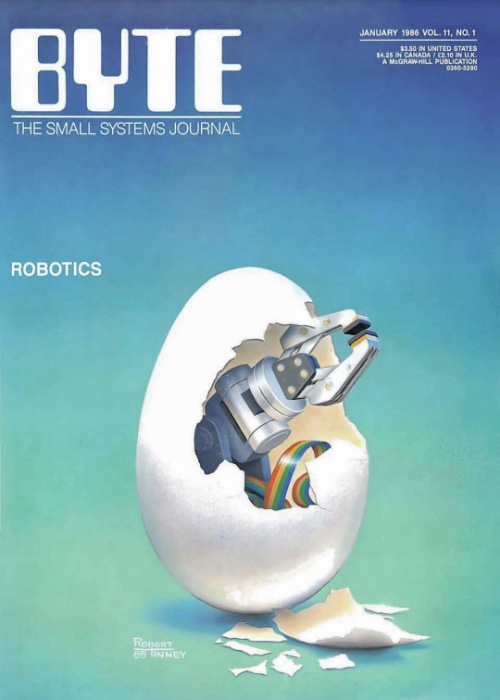
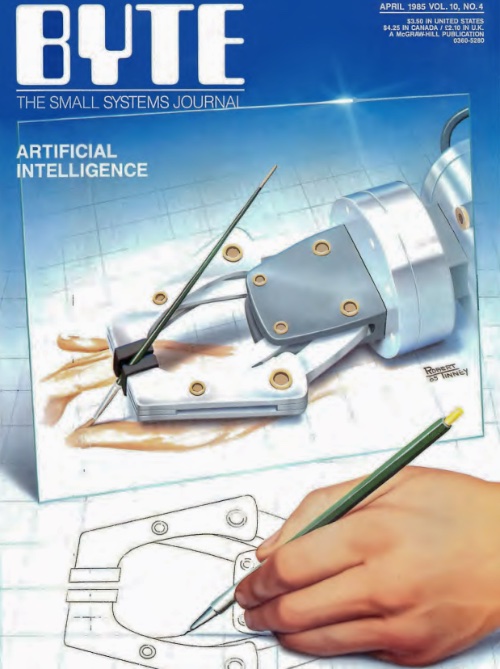
If you were into computers in the ‘80s, you may not know his name, but you definitely know his work: He was the artist behind the beautiful hand-painted covers of the influential computer hobbiest [sic] magazine Byte from the December 1975 issue until the early ‘90s.
Rowe links to an interview with Tinney in Byte itself for its tenth anniversary issue. Oddly, it seems like Tinney did not even own a computer for the first eight or nine years of Byte:
It has been about a year and a half now since I got my first computer, a Morrow Micro Decision. It’s very useful and I love it. It came with some bundled software. I use WordStar to do all my business correspondence. And I use Personal Pearl to keep track of a database of customers who have ordered BYTE cover reprints.
That whole interview is worth reading. Tinney seems to have acutely predicted that computers and drawing tablets would have a huge impact on art in the future.
My dad was a huge Byte reader — there’s a large number of Xerox paper boxes in his attic filled with print issues of Byte from most of its run. He had a pair of Tinney prints hanging in his home office for my whole childhood. Once he remodeled that room, the prints came down, and now they’re hanging in my own home office. The two pieces, “Intelligent Reflections” and “Technological Breakthrough,” sit well together. (You can apparently still buy them today.)
One last odd thing from Rowe’s summary is this:
Tinney was also a big libertarian, an ethos he shared with Byte founding editor Carl Helmers, who initially brought Tinney onboard in 1975.
In fact, it’s deeper than that: I haven’t seen this mentioned anywhere else online, but according to a 2013 talk from Helmers himself, the two first met in Houston in 1972 when Helmers bought Tinney’s black and white print of a “graphic on an Atlas Shrugged theme of somebody holding up the world.”
That’s right, Tinney’s entire Byte career emerged from his love for Ayn Rand.
People contain multitudes, I guess.